
Care Connected
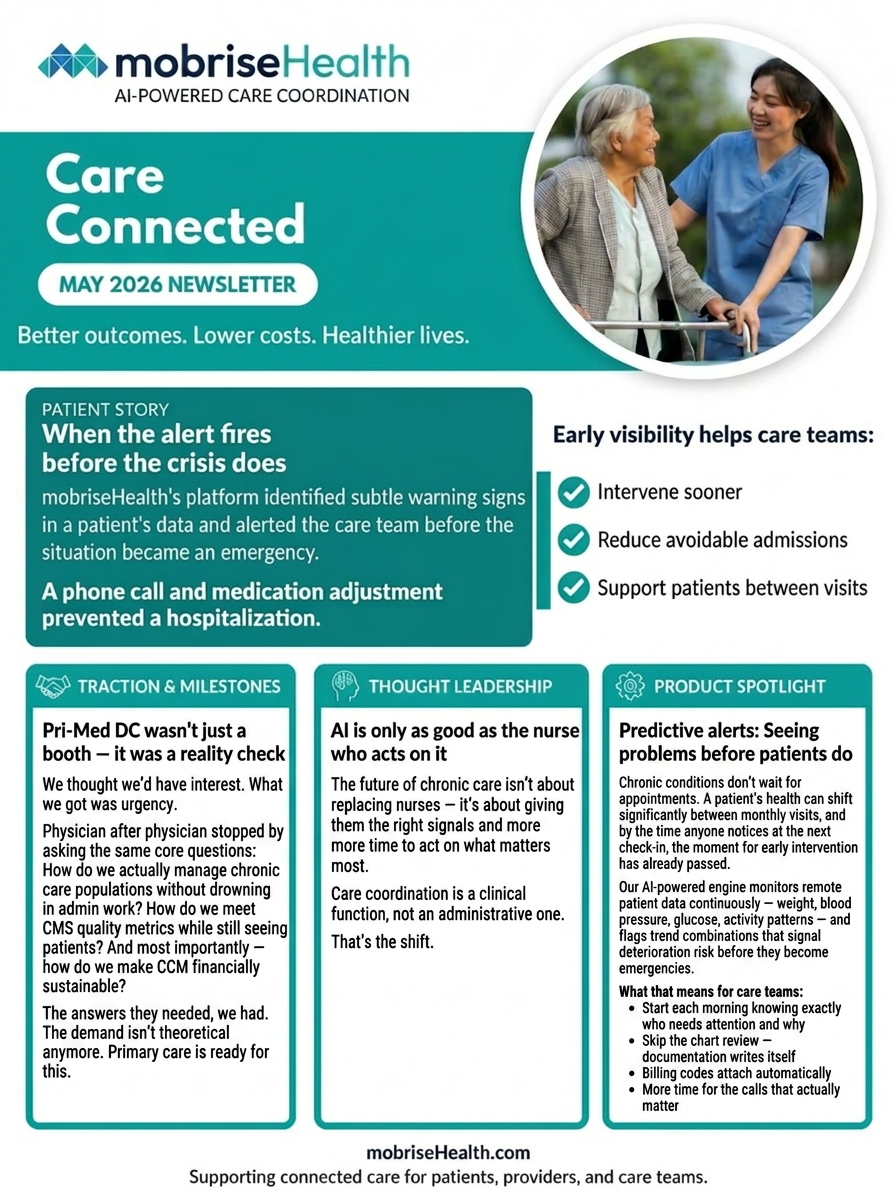
Table of Contents
The people who need the most care are getting the least of it — and everyone in the room already knows it.
Older adults with multiple chronic conditions account for a disproportionate share of hospitalizations and avoidable spending. The gap is not clinical knowledge — it is operational capacity. Care teams are stretched too thin to catch early warning signs, and the systems they rely on were not built for the patient population we have now. That is the problem mobriseHealth was built to solve.
When the alert fires before the crisis does
A 74-year-old managing heart failure and Type 2 diabetes is enrolled in remote patient monitoring. On a Tuesday, her weight trends up three consecutive days. Blood pressure follows. Nothing alarming in isolation — but mobriseHealth's platform flags the pattern and routes a predictive alert to her care coordinator before the morning huddle starts.
She did not want to bother anyone. The platform made sure someone noticed anyway.
The coordinator calls. The patient mentions feeling puffy and short of breath at night. Her physician adjusts her diuretic that afternoon. No ER visit. No admission. The intervention costs a phone call and a prescription change. The alternative would have cost the system thousands and the patient far more.
↑ Back to ContentsPri-Med DC was a proof point, not a trade show
mobriseHealth exhibited at the Pri-Med DC conference last month, one of the premier CME events for primary care physicians on the East Coast. We expected interest. What we experienced was urgency. Primary care doctors crowded our booth because the operational problem mobriseHealth solves is one they live with every day: chronic care management accountability, CMS quality metrics, and the administrative burden of doing it all manually.
The question we heard most: how does this connect to billing? CMS reimbursement for CCM and RPM is a significant, largely uncaptured revenue opportunity for primary care. mobriseHealth's automated documentation, reimbursement-ready coding support, and CPT-aligned workflows make that sustainable. The demand is real, the infrastructure is in place, and primary care is the distribution channel.
↑ Back to ContentsAI in chronic care is only as good as the nurse who acts on it
The conversation around AI in healthcare often skips the most important variable: the nurse or care coordinator who receives the alert and decides what to do. As the aging population grows and the nursing shortage deepens, the leverage point is not replacing clinical judgment — it is giving nurses fewer decisions about what to look at and more time to act on what matters. Practices that age well alongside their patients will be those that treat care coordination as a clinical function, not an administrative one. That is the shift mobriseHealth is building toward.
↑ Back to ContentsPredictive alerts: catching what the visit cycle misses
Chronic disease does not follow a schedule. A patient's condition can shift significantly between monthly check-ins, and by the time anyone notices, the window for early intervention has closed. mobriseHealth's predictive alert engine monitors RPM data continuously — weight, blood pressure, glucose, activity — and surfaces trend combinations associated with deterioration risk before they become emergencies. Care teams start each day with a prioritized view of who needs attention and why. Documentation is automated. Billing codes are attached. Time that used to go into chart review now goes into patient contact.
↑ Back to Contents