
The Hidden Cost of Poor Care Coordination
Most practices do not struggle because they lack data. They struggle because they cannot act on it in time. A patient’s blood pressure trends upward for weeks. A diabetic patient misses medications. A high risk patient shows early warning signs. The signals are there, but without effective care coordination, nothing happens when it should. That delay is where the real cost begins.
The gap between data and action remains one of the biggest challenges in care delivery. Tools have improved and access to patient information is better than ever, yet outcomes have not kept pace. In many practices, staff still spend time manually reviewing dashboards, sorting through alerts that are too frequent or not actionable, and following up based on availability rather than urgency. Billing workflows often remain disconnected from clinical activity. As a result, important changes are missed, interventions happen too late, and care becomes reactive instead of proactive.
At the same time, the healthcare environment is changing. Value based care models are expanding, reimbursement is increasingly tied to outcomes, and staffing shortages continue to put pressure on operations. Audit scrutiny around documentation is also rising. Patient expectations are evolving as well. Care is no longer defined only by what happens during visits, but by what happens between them. Practices that cannot coordinate care continuously are beginning to fall behind.
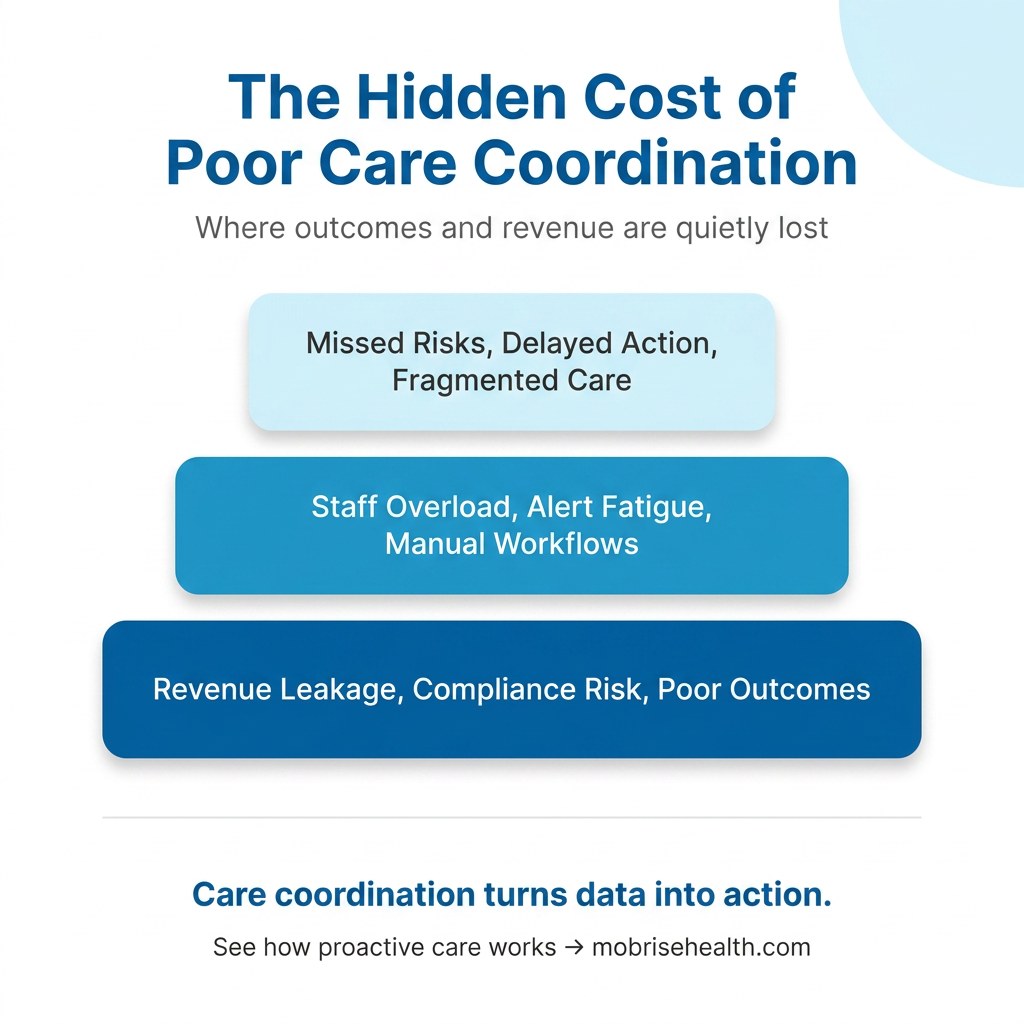
Care coordination cost
The cost of poor care coordination does not show up in one place. It appears across clinical, operational, and financial dimensions. Missed early signals can lead to avoidable complications. Staff spend valuable time chasing data and managing fragmented workflows instead of focusing on patient care. Revenue opportunities through RPM and CCM are often underutilized, and inconsistent documentation increases audit risk. While each issue may seem manageable on its own, together they create a system that is inefficient and difficult to scale.
Effective care coordination changes this dynamic. It is not an additional layer of work, but the mechanism that ensures the right action happens at the right time. In a well coordinated model, patient data is monitored continuously, risks are identified early, and tasks are prioritized based on clinical need. Care teams know who requires attention and why, and documentation aligns naturally with billing. The focus shifts from simply collecting data to driving meaningful action.
Consider a patient with hypertension. Without strong coordination, blood pressure readings may increase gradually without triggering timely action, leading to delayed medication adjustments. With effective coordination, those trends are identified early, the care team is alerted with context, and follow up happens sooner. The outcome is not driven by having more data, but by acting on it at the right time.
When care coordination improves, the operational impact becomes clear. Staff spend less time on manual review, follow ups become more targeted, and billing becomes more consistent and defensible. Patient engagement improves, and outcomes across the patient population are better. Importantly, practices are able to scale without adding proportional staff, which is critical in today’s environment.
The challenge has never been collecting data. It has been prioritizing and executing on it. AI driven workflows are now helping bridge this gap by continuously analyzing patient data, highlighting what needs attention, guiding care teams on next steps, and supporting documentation aligned with billing requirements. This does not replace clinicians, but supports them by removing noise and focusing attention where it matters most.
Better care does not happen only during visits. It happens in the decisions made between them. Practices that invest in effective care coordination are not just improving workflows, but building a foundation for better outcomes, stronger financial performance, and sustainable growth.
See how proactive care coordination works → mobrisehealth.com